
Braking Resistors
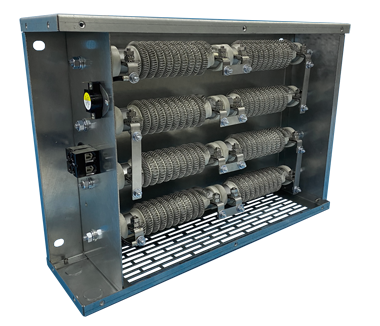
AC variable-speed drives create regenerated energy when a motor decelerates. That energy must be dissipated through a braking resistor to prevent over-voltage shutdowns. A properly designed braking resistor provides an economical, dependable solution and improves deceleration control.

Deceleration vs. overhauling-load braking
There are two distinct braking scenarios. In deceleration braking the energy varies over the braking period. In overhauling-load braking the energy is constant, requiring the resistor to absorb roughly twice the power of a deceleration application.
Duty-cycle calculations
- Deceleration braking: (Braking Time ÷ Cycle Time) × 100% × 0.5
- Overhauling-load braking: (Braking Time ÷ Cycle Time) × 100%
How to specify
- By Ohms and Watts, or
- By Drive HP, Drive Voltage, Duty Cycle and Braking Torque
Standard construction
- Crohm Series CW wirewound or CE edgewound resistors
- Indoor screened or outdoor louvered enclosures
- Galvanized or stainless steel finishes
- High-temperature wiring and lugs
- Terminal-block connections
Accessories & options
- Protective indoor / outdoor enclosures
- Custom engineered assemblies
- Thermal overload protection
- Stainless steel construction
Related products
Get a quote
Ready to spec your resistor?
Send us your ohms and watts — or your drive, voltage and duty cycle — and our engineers will build a reliable, economical solution.